When floodwater enters your Auckland home, a countdown begins. In the first 60 minutes, the damage is often containable. By 24 hours, restoration costs can double. After 48 hours, mould begins to grow. Within a week, structural integrity may be compromised beyond simple repair. The speed of your response after a flood is the single biggest factor determining the final cost, duration, and outcome of the restoration process.
At iDry Restorations, we've built our entire operation around one principle: every minute counts. Our 60-minute response commitment exists because we've seen first-hand — across thousands of flood emergencies in Auckland — just how dramatically outcomes differ between properties that receive immediate professional attention and those where response is delayed.
This article breaks down exactly what happens to your property as the clock ticks after a flood, what professional emergency responders do to stop the damage, and why having a plan in place before disaster strikes could save you tens of thousands of dollars.
The Flood Damage Timeline: How Water Destroys Your Property Hour by Hour
Water is relentless. It doesn't just sit on the surface — it actively penetrates, absorbs, wicks, and migrates through every material it contacts. Understanding this timeline helps explain why emergency response speed is so critical.
0 to 60 Minutes: The Golden Hour
The first hour after flooding is the most critical — and the most hopeful. During this window:
- Water sits primarily on surfaces — It pools on floors, settles on carpets, and begins to soak into the base of walls and cabinetry. But penetration into structural materials is still relatively shallow.
- Carpet and underlay absorb water — Carpet acts like a sponge, absorbing water rapidly. However, within the first hour, the carpet and underlay can often be salvaged through professional extraction and drying.
- Electronics and appliances are at risk — Water reaching electrical sockets, appliances, and wiring creates immediate safety hazards. Power should be disconnected if safe to do so.
- Furniture begins absorbing moisture — Timber furniture legs sitting in water start wicking moisture upward, but damage at this stage is typically reversible if items are elevated quickly.
Key takeaway: If professional water extraction begins within the first hour, the majority of materials — including carpet, underlay, timber flooring, and plasterboard — can usually be saved through drying rather than replacement. This is the cheapest, fastest, and least disruptive restoration scenario.
1 to 24 Hours: Escalating Penetration
Once the first hour passes without professional intervention, water begins causing significantly deeper damage:
- Water wicks up walls — Through capillary action, water climbs up plasterboard (GIB) and timber framing. After several hours, moisture can travel 300mm to 600mm above the visible waterline. This hidden moisture is what causes the most expensive damage.
- Timber flooring begins to swell — Engineered and solid timber floors absorb water and expand. If drying doesn't begin within 12 to 24 hours, cupping, crowning, and permanent warping can occur, requiring full floor replacement rather than restoration.
- Plasterboard deteriorates — GIB board absorbs water aggressively. After 12 to 24 hours of exposure, the paper facing begins to delaminate and the gypsum core weakens. Plasterboard exposed for extended periods typically needs replacement.
- Subfloor areas flood — Water migrates under flooring and into subfloor cavities, where it becomes trapped. Without professional detection equipment, this hidden water continues causing damage long after surface water is removed.
- Contents damage worsens — Books, documents, photographs, clothing, and upholstered furniture suffer increasing damage. Some items that could have been saved with immediate attention become unrecoverable.
- Odours develop — Stagnant water begins producing unpleasant smells as organic matter in carpets, underlay, and dust becomes waterlogged.
Cost impact: Restoration costs at the 24-hour mark are typically 50% to 100% higher than if professional extraction had begun within the first hour. Materials that could have been dried must now be removed and replaced.
24 to 48 Hours: The Mould Threshold
This is the period restoration professionals dread — because it's when a water damage problem becomes a water damage and mould problem.
- Mould spore germination begins — In Auckland's warm, humid climate, mould spores that are naturally present in every home begin to germinate when relative humidity exceeds 60% and organic materials remain wet. Within 24 to 48 hours, invisible colonies begin establishing themselves behind walls, under floors, and in ceiling cavities.
- Bacterial growth accelerates — Floodwater, particularly if it contains sewage or external runoff, supports rapid bacterial growth. Contaminated materials become a health hazard.
- Metal components begin corroding — Nails, screws, brackets, and electrical fittings exposed to water start corroding. Hidden corrosion in wall framing and electrical systems can create long-term structural and safety issues.
- Adhesives and sealants fail — Floor tiles, laminate, vinyl, and wallpaper begin lifting as adhesives break down from prolonged moisture exposure.
Critical fact: Once mould becomes established, the restoration scope expands dramatically. What started as a water extraction and drying job now requires mould remediation, containment, and often removal of affected materials. Mould remediation alone can add $3,000 to $20,000+ to the total cost.
48 Hours to 1 Week: Structural Compromise
- Mould growth becomes visible — Black, green, or white fuzzy patches appear on walls, ceilings, furniture, and in concealed spaces. Mould can spread at a rate of several centimetres per day under favourable conditions.
- Timber framing begins to warp and weaken — Structural timber that remains wet for days starts losing its load-bearing capacity. Swelling can shift wall alignments and door frames.
- Insulation becomes waterlogged and useless — Fibreglass and polyester insulation in walls and ceilings holds water like a sponge, creating a perfect environment for mould and preventing surrounding materials from drying.
- Electrical systems are compromised — Wiring, switchboards, and power points exposed to prolonged moisture require professional inspection and potentially full rewiring.
- Health risks increase significantly — Airborne mould spores, bacteria, and volatile organic compounds from decomposing materials create genuine health hazards, particularly for children, elderly residents, and those with respiratory conditions.
1 Week and Beyond: Major Reconstruction Required
Properties that go a week or more without professional restoration intervention typically require extensive reconstruction rather than restoration:
- Plasterboard requires full replacement — Often floor to ceiling, not just the lower sections
- Timber framing may need sistering or replacement
- All floor coverings require removal and replacement
- Insulation must be stripped and replaced
- Complete mould remediation is required before any rebuild work can begin
- Contents are largely unrecoverable
Cost impact: What might have been a $5,000 to $10,000 restoration with immediate response can escalate to $30,000 to $80,000 or more after a week of delay. Some Auckland homeowners have faced six-figure bills after extended delays during major flooding events.
What Professional Emergency Flood Responders Do First
Understanding what happens when a professional restoration team arrives helps explain why their response is so much more effective than attempting to manage flooding on your own.
Step 1: Rapid Safety and Damage Assessment
The first thing our IICRC-certified technicians do is assess the situation for safety — checking for electrical hazards, structural instability, and contamination risks. Simultaneously, they use professional moisture meters and thermal imaging cameras to map the full extent of water penetration, including behind walls and under floors where damage isn't visible to the naked eye.
This assessment takes approximately 15 to 30 minutes and provides the roadmap for the entire restoration. Without it, hidden moisture gets missed, leading to mould and ongoing damage weeks or months later.
Step 2: Industrial Water Extraction
Professional flood response teams use industrial-grade extraction equipment that operates on a completely different scale to anything available to homeowners:
- Truck-mounted extractors — Capable of removing thousands of litres per hour, these units extract standing water from floors, carpets, and underlay far faster and more thoroughly than any household wet vacuum or mop.
- Weighted extraction tools — Specialised tools press into carpet to extract water trapped deep in the pile and underlay, recovering moisture that surface extraction misses.
- Submersible pumps — For severe flooding with deep standing water, industrial pumps rapidly lower water levels.
Step 3: Structural Drying Setup
Once standing water is extracted, the critical process of structural drying begins. This is where professional equipment makes the difference between saving materials and having to replace them.
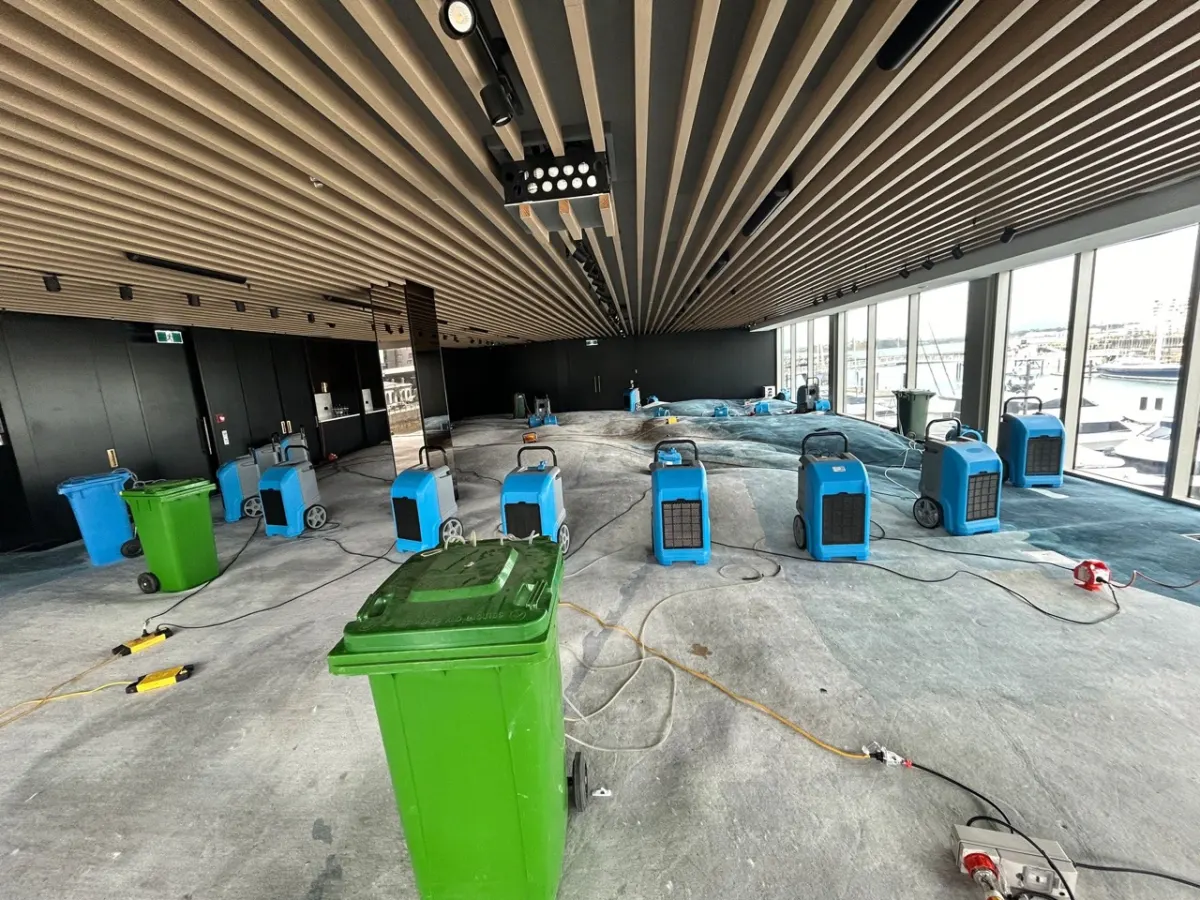
- Commercial dehumidifiers — Industrial units remove 50 to 100 litres of moisture from the air per day (compared to 10 to 20 litres for household units). Multiple units are typically deployed throughout the affected area.
- High-velocity air movers — These professional fans create targeted airflow across wet surfaces, dramatically accelerating evaporation from walls, floors, and cavities.
- Desiccant drying systems — For particularly challenging drying situations (such as concrete slabs or heavily saturated wall cavities), desiccant systems provide intense, targeted drying.
- Cavity drying systems — Specialised equipment that injects warm, dry air into wall cavities and subfloor spaces to dry structural timber and insulation without removing wall linings.
Step 4: Documentation and Insurance Coordination
From the moment our team arrives, we document everything — moisture readings, photographs, video, and detailed notes. This documentation serves two essential purposes: it guides the restoration process, and it provides your insurance company with the evidence they need to process your claim efficiently. Our team has extensive experience working with all major New Zealand insurers and can liaise directly with your insurer on your behalf.
Industrial Equipment vs. Household Tools: A Comparison
Many Auckland homeowners attempt to manage flooding themselves using household equipment. While we understand the impulse to take immediate action, it's important to understand the limitations:
- Household wet vacuum: Removes approximately 20-40 litres per hour from surfaces. Industrial extractor: Removes 500-2,000+ litres per hour from deep within materials.
- Household dehumidifier: Removes 10-20 litres of moisture per day. Commercial dehumidifier: Removes 50-100+ litres per day with precise humidity control.
- Box fans and open windows: Provide general air circulation but no targeted drying. Professional air movers: Create concentrated, high-velocity airflow precisely directed at wet materials.
- Visual inspection: Can only see surface-level damage. Thermal imaging and moisture meters: Detect hidden moisture behind walls, under floors, and in ceiling spaces.
The bottom line: Household tools might handle a minor spill, but for any flooding event — whether from a burst pipe, overflowing bath, or storm — professional equipment and expertise are essential to prevent hidden damage, mould growth, and escalating costs.
Why 24/7 Availability Matters
Floods and water emergencies don't respect business hours. In our experience across Auckland, some of the most damaging incidents occur at the worst possible times:
- Pipe bursts at 2am — When the household is asleep, a burst pipe can discharge water for hours before anyone notices
- Weekend storms — Auckland's severe weather events frequently occur on weekends when many restoration companies are closed
- Public holiday flooding — Major Auckland flooding events, including the January 2023 Anniversary floods, occurred on public holidays
- Evening appliance failures — Washing machines, dishwashers, and hot water cylinders commonly fail during evening use
A restoration company that only operates during business hours leaves you waiting 12 to 16 hours or more — well past the critical window where the difference between drying and replacement is decided. iDry Restorations maintains fully equipped response vehicles and on-call IICRC-certified technicians 24 hours a day, 7 days a week, 365 days a year. When you call at 3am on a Sunday, you get the same response time and the same level of expertise as you would at 10am on a Tuesday.
The Real Cost Impact of Delayed Response
To put the urgency into real numbers, here's what we typically see across Auckland flood restoration jobs:
Scenario: Burst Pipe in a Three-Bedroom Auckland Home
- Response within 1 hour: Water extraction, structural drying, carpet and underlay saved. Estimated cost: $3,000 - $6,000. Duration: 3-5 days of drying.
- Response at 12 hours: Water extraction, some carpet and underlay requires replacement, plasterboard drying with some sections needing replacement. Estimated cost: $8,000 - $15,000. Duration: 5-10 days.
- Response at 24 hours: Full carpet and underlay replacement, significant plasterboard replacement, mould prevention treatment required. Estimated cost: $15,000 - $25,000. Duration: 2-3 weeks.
- Response at 48+ hours: Complete strip-out of affected areas, mould remediation, full rebuild of walls, floors, and fixtures. Estimated cost: $25,000 - $50,000+. Duration: 4-8 weeks.
The pattern is unmistakable: every hour of delay compounds the damage and cost exponentially. What is a straightforward extraction and drying job in the first few hours becomes a major reconstruction project within days.
iDry's 60-Minute Response Commitment
At iDry Restorations, our 60-minute response commitment isn't a marketing slogan — it's the operational foundation of our business. Here's what makes it possible:
- Strategically located response teams — We maintain teams positioned to reach any Auckland suburb within 60 minutes, from Orewa to Papakura, Piha to Howick.
- Pre-loaded response vehicles — Our trucks are permanently equipped with extraction units, dehumidifiers, air movers, moisture detection equipment, and PPE. There's no delay waiting for equipment.
- IICRC-certified technicians on call 24/7 — Our technicians hold current IICRC Water Damage Restoration (WRT) certifications and undergo regular training to maintain the highest industry standards.
- Direct dispatch system — When you call 0800 452 199, your call is answered by our team (not an answering service), and a response vehicle is dispatched immediately.
How to Prepare for a Flood Emergency
The best time to prepare for a flood emergency is before it happens. Taking these steps now will ensure you can respond quickly when every minute matters:
- Save iDry's emergency number in your phone now: 0800 452 199. Programme it as a contact so you can find it instantly in a crisis — not when you're standing in ankle-deep water searching the internet.
- Know where your toby (mains water shutoff) is located and ensure it operates freely. For pipe bursts, shutting off the water supply immediately can prevent thousands of litres of additional damage.
- Know where your electrical switchboard is and how to shut off power to affected areas safely. Never enter standing water with live electricity.
- Keep important documents and valuables elevated — Store irreplaceable items, important documents, and electronics above ground level, particularly if you live in a flood-prone Auckland area.
- Review your insurance policy — Know what your policy covers for flood and water damage before you need to make a claim. Understanding your excess and coverage limits helps you make informed decisions during an emergency.
- Create a household emergency plan — Ensure everyone in the household knows what to do if flooding occurs: where to shut off water and power, who to call, and where to assemble safely.
For more detailed guidance on what to do immediately after a flood in your Auckland home, read our comprehensive step-by-step guide.
Auckland's Storm Season: Be Ready Before It Hits
Auckland's primary storm season runs from May through September, with the most intense rainfall events typically occurring in June, July, and August. However, as the 2023 Anniversary floods demonstrated, catastrophic rainfall can occur at any time of year.
Key preparation steps for storm season include:
- Complete all roof, gutter, and downpipe maintenance before May
- Clear ground-level drains and stormwater grates around your property
- Check that sump pumps are operational if your property has them
- Ensure your property's drainage can handle heavy rainfall — Look for areas where water pools during rain and address grading or drainage issues
- Stock basic emergency supplies — Torches, batteries, towels, and a battery-powered radio
- Monitor MetService weather warnings and Auckland Emergency Management alerts during severe weather
Properties in known flood-prone areas — including parts of Onehunga, Grey Lynn, Western Springs, Westmere, Avondale, and low-lying areas of South Auckland — should take additional precautions, including considering flood barriers and ensuring comprehensive insurance coverage.
The same urgency applies to other types of property damage. Delayed response to fire damage allows smoke residues to permanently stain surfaces, while untreated moisture from any source leads to mould growth that compounds restoration costs significantly. Fast action is equally critical for meth contamination and biohazard situations where health risks escalate with every hour of exposure.
When disaster strikes, don't wait. Every minute of delay increases the damage, the cost, and the disruption to your life. iDry Restorations is Auckland's fastest emergency flood response team — call us at 0800 452 199 for immediate assistance, any time of day or night.